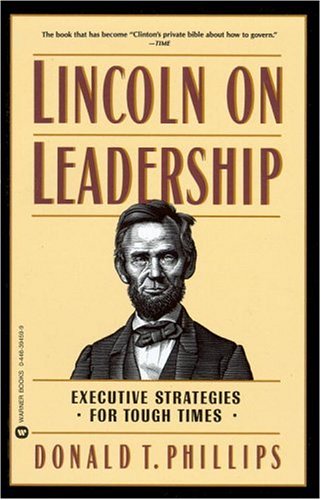
Lincoln on Leadership: Executive Strategies for Tough Times. By Donald T. Phillips New York, NY: Warner Books, 1992, 188 pp., (paperback).
Donald T. Phillips, nonfiction writer, public speaker and former political office holder, presents a fascinating, well-researched account of the leadership abilities of Abraham Lincoln. Phillips’s book, Lincoln on Leadership: Executive Strategies for Tough Times, is both a history text and a leadership manual, full of easily digestible nuggets of wisdom from America’s sixteenth president. Phillips uses letters, historical documents, and anecdotes from President Lincoln, as well as his colleagues, family, and political peers to provide solid evidence of Lincoln’s leadership prowess. Through examples of the president’s actions and character, the reader is given practical managerial advice, as well as how to apply this advice in modern-day business situations.
The almost conversational style of the book makes it as entertaining as it is informative to read. Lincoln on Leadership is divided into four main sections: People, Character, Endeavor, and Communication. Each section details one aspect of an effective leader. Section one focuses on people and Abraham Lincoln’s interactions with his subordinates. Section two hones in on Lincoln’s character in and out of the office of president. The third section of the book gives us Lincoln’s dynamic decision-making strategies. The last quarter of the book is dedicated to Lincoln’s effective communication style and the ways in which he won people over with his intimate conversations and oratory expertise. With each section, we are shown how Lincoln eloquently responds to the rising political strife associated with the Civil War and public criticism of his presidency and personal character. We are also shown how Lincoln’s actions can be employed in the contemporary workplace. Phillips shows us how we as leaders can be “catalysts for change” (1992, p. 137) in our offices and how Lincoln’s tough but fairrelationships with his cabinet members translates to close working relationships with our own staff.
Phillips is correct when he says that “our vision” of Abraham Lincoln is of someone who is “more mythical than real” (1992, p.1). In Lincoln on Leadership, President Lincoln is portrayed as more monolith than man, seeming almost superhuman in his leadership perfection. His managerial style is described in such a way that leaves Lincoln shining, with no faults, as if he never made any blunders. I worry that such a depiction leaves those of us who wish to follow Lincoln’s example grasping for an unattainable flawlessness. Though Phillips shows us glimpses of the president’s humanity when Lincoln loses his temper, pardons deserting soldiers, or uses a saucy parable to school an upstart opponent, we get none of the backstory on how he grew to become the leader that we herald. If we were allowed behind the curtain to see more examples of situations in which Lincoln rose above his mistakes, then we can learn how to better fix our own leadership shortcomings. We, like Lincoln, aren’t born great leaders; we become them through practice, through trial and error.
Though Phillips’s purpose for writing this book is to give “lessons and principles” to “contemporary business and political leaders” (Phillips, 1992, p. 9), I would recommend this book to anyone in a leadership position, particularly those who find themselves stepping into the responsibility of leading an already fractured team. In the same way Lincoln’s actions helped heal the fissure in the post-war United States, the same principles of listening to your subordinates, having a distinct vision, and leading with authority still apply today. Teachers, administrators, and those working in the field of Higher Education will benefit from Lincoln’s practical wisdom.
References
Biography. (2013). Retrieved from http://www.donaldtphillips.com/biography.html
Phillips, D. T. (1992). Lincoln on leadership: Executive strategies for tough times. New York,
NY: Warner Books.
 Wylijanna Cole, M.Ed.